Showing posts with label HTDN:Bioregions. Show all posts

Friday, May 01, 2020

Bioregion: Crosswords

Bear with me.

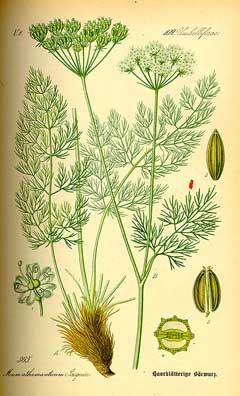
Spignel. Penstemon. These were just two of the recent plants that I came across in trying to complete puzzles in The Times Jumbo Cryptic Crossword Book (5th entry in this series). Plants where I knew how to get at the answer (the former an anagram of pleasing without the "a," the latter a combo of a synonym for "writes" and an anagram of "Monet"), but I didn't have enough horticultural knowledge to get the right answer, and had to resort to looking up plants that I thought should exist.

Before, I had been just finding the answer and moving on. Now, with lockdown and the increased sense of curiosity I'm trying to cultivate regarding the natural world, I have been looking them up. Penstemons do not trigger any memories for me, but spignel... something I have seen on every walk in the countryside at home, yet have never known the name of, nor cared to find it. Just part of the scenery, something there to observe but not investigate or get to know. That saddens me, but also opens up such a world of potential for observation and a deeper experience in future walks.


It also deepens my experience from my lockdown living room, too.

Quaking Aspen. Trembling Aspen. Trembling Poplar (this being the answer). All different names for the same tree, all delightfully evocative.

Asphodel. A pretty, elegant flower; also the flower of the Elysian Fields, apparently, and one whose name and story I only encountered through a crossword last week. It's also mentioned in many, many poems, and led me to this by William Carlos Williams (excellent name), Asphodel, That Greeny Flower:
Of asphodel, that greeny flower,
                        like a buttercup
                                                upon its branching stem-
save that it's green and wooden-
                        I come, my sweet,
                                                to sing to you.
We lived long together
                        a life filled,
                                                if you will,
with flowers.  So that
                        I was cheered
                                                when I came first to know
that there were flowers also
                        in hell.
And, heading further down the rabbit-hole, this poem, lauded for being about a love poem to a wife and not a mistress is, it turns out, from a man facing his mortality, causing him to profess his love and confess all his adultery.

Still.  The poem is pretty and so is the plant. I'll leave you with that.


Saturday, April 11, 2020

Bioregion: Birds

I bought the Field Guide to the Natural World of New York City by Leslie Day (foreword by Bloomberg completely ignored) just before the lockdown started; sadly, I've not been able to use it as I would like as a result. Not only have I not been going out as much, but far too many of my walks are with hunched shoulders to try to keep my scarf on or tense because I'm irritated at people who haven't understood what six foot or social distancing mean (obviously, in this scenario, I have convinced myself I know how to behave and therefore am in a fine place to pass judgment on others' perceived non-compliance). Accordingly, it's been hard to stop and observe the nature around me - a sudden stop doesn't help with keeping the requisite distance and feels self-indulgent (ignore the expression of this thought through blogging).

We have seen a lot of sparrow life in the last few weeks - sparrows fat, sparrows thin, sparrows large and small. So I looked them up. All the ones we see are house sparrows. Apparently, 100 were introduced to the US in 1850-51; there are now 150 million + here, and they are the most common bird in New York City.

The lockdown has coincided with the arrival of the first starlings I've seen in New York this year. I adore starlings - their glossy, shiny coat of that remarkable bluey-purpley-greeny-black, that oil puddle like sheen; the flecks; and their glorious flocking in those seething, chattering balls, the gloriously named murmurations. European starlings were introduced as a result of an attempt to introduce all bird species named in Shakespeare to the US. (Result: over 200 million starlings now reside in the US).

The presumptive imperialism here - the expansionism, lack of regard for native beings, and the whimsy of Shakespearean birds (who could possibly argue against it!) - is rather breathtaking; how many other things like this did we do that I'm never going to know about?

Nonetheless, for your viewing pleasure, here is a murmuration somewhere else that my people decided was theirs.


Monday, March 09, 2020

Bioregion: Sweet Gum

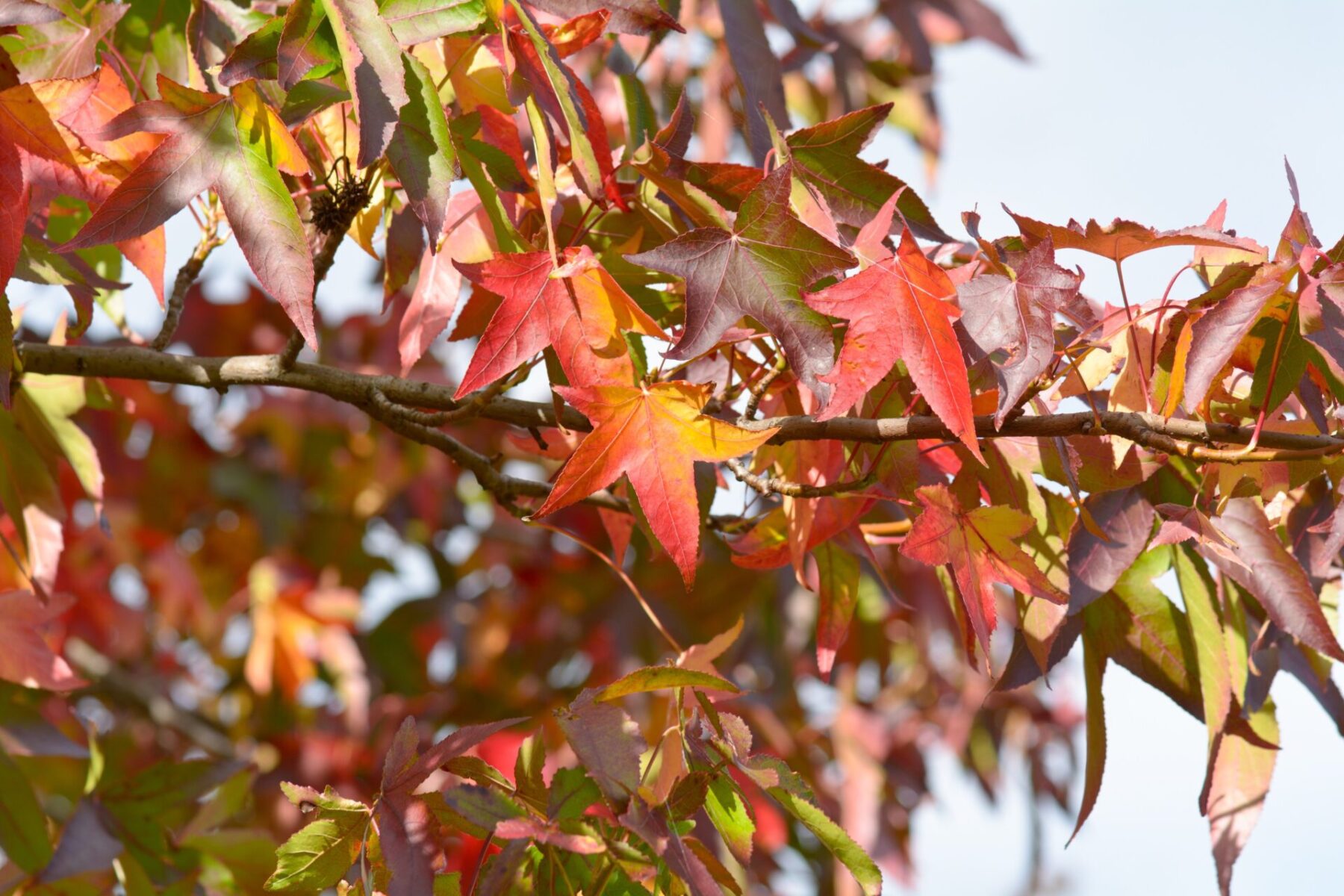
In How to Do Nothing, Jenny Odell argues for getting to know ones bioregion. If I hadn't been persuaded by the rest of the book (note: I had), remembering something from my in-laws' last visit at the end of 2019 should have prompted me to at least reconsider my relationship with my local surroundings. My in-laws were fascinated by a particular type of tree that I had noticed, vaguely, but had no idea what it was or enough curiosity to investigate it. That, now, seems embarrassing and odd - why didn't I have that interest to know more? Why don't I look up? Why do I take the trees and blossom for granted? I enjoy the foliage a huge amount, both when green and when in the blaze of autumnal colours that hits us here; blossom and the feel of freshness and new life in spring provides me with a huge boost each year (and annoyance that it comes so late in New York). My goal is, therefore, to learn something new about the nature around me each week.

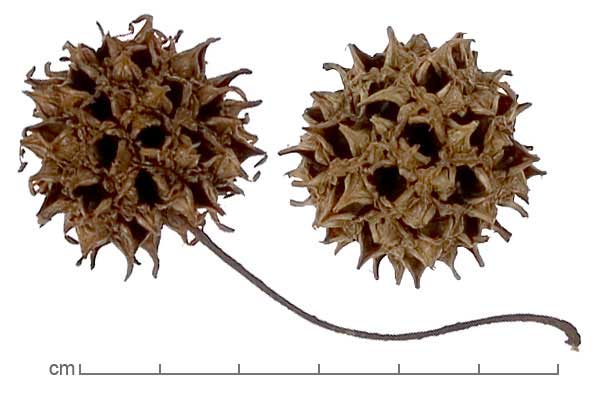
Our kid is obsessed with small, hard seed pods that he finds round the roots of various trees in Brooklyn. He calls them lollipops, sometimes, with an occasional early ill-advised attempt or two to bite into one. Until today, I hadn't thought about what they were, despite my abiding love of conkers and other fascinating ways in which trees distribute their seeds.


So, yesterday, I called up my app - Picture This, if you're interested - and found out what they were. These are sweet gum seedpods, and sweet gums grow all over the US, but not much further north than NYC.

The Nahuatl name provides answers for how it interacts with us: Ocotzocuahuitl, which translates to tree that gives pine resin from ocotl (pine), tzotl (resin), cuahuitl (tree), which refers to the use of the tree's resin - it was used, among other things, to flavour tobacco. While that is less common, it is apparently still used as a mild antiseptic or to treat sores (???). Although the pods are lumpy and spiky, goldfinches, purple finches, squirrels, and chipmunks manage to eat its seeds. Humans also use the infertile seeds to create one of the major chemicals in the Tamiflu treatment, somewhat unbelievably - they contain shikimic acid, something discovered after there was a shortage of star anise (which is another rabbit hole I want to go down, but am trying to resist). How do you tell which are infertile? According to Eat the Weeds, "[f]ertile seeds are black with wings on either side, infertile seeds are yellow and wingless." The pods have many names: "burr (or bir) balls", "gum balls", "space bugs", "monkey balls", "bommyknockers" or "sticker balls".


A list of alternate names for sweet gums (some which will clearly help with Scrabble): American storax, hazel pine, bilsted, redgum, satin-walnut (particularly pleasing), star-leaved gum, alligatorwood (due to the way the bark looks, apparently), or simply sweetgum.

These trees blaze up the parks in Brooklyn in October and November; the leaves litter the ground in November and December; I cannot wait until that happens.


Sources: